The nine states that did not ratify the 22nd Amendment

The 22nd Amendment prohibits Donald Trump from being elected to a third term as president of the United States. Nevertheless, Trump and his allies are threatening the possibility of a 2028 presidential run. In a recent interview, the president said, “Based on what I read, I guess I’m not allowed to run,” before equivocating, “So we’ll see what happens.”
In light of these recent developments, understanding the history of the 22nd Amendment is more important than ever. CREW recently published a report about the 41 (of then 48) states that ratified the amendment between 1947 and 1951. Alaska and Hawaii would not enter the union as the 49th and 50th states for several years. But what about the remaining seven states? A look at historical records reveal that Republican efforts to ratify the 22nd Amendment were thwarted by Democratic leadership, even in states where the amendment enjoyed bipartisan support. Despite the seven outlier states that failed to ratify the 22nd Amendment, a review of relevant case law from those states in the 75 years since ratification confirm broad support for and a consistent understanding of the presidential term limit and the amendment’s enduring place in our legal jurisprudence.
Presidential Term Limits Meet Partisan Gamesmanship in Outlier States
The 22nd Amendment became part of the Constitution of the United States in February 1951 after ratification by a supermajority of state legislatures. Forty-one states ratified the amendment—five more states than the necessary 36 state threshold at the time. They included states led by Democrat and Republican controlled legislatures, as well as bipartisan supermajorities in several states. Despite the overwhelming support won by the 22nd Amendment, seven state legislatures either failed to consider or defeated resolutions to ratify the amendment. Each state process was marked by both support and partisan gamesmanship that ultimately led to the amendment’s defeat.
Arizona
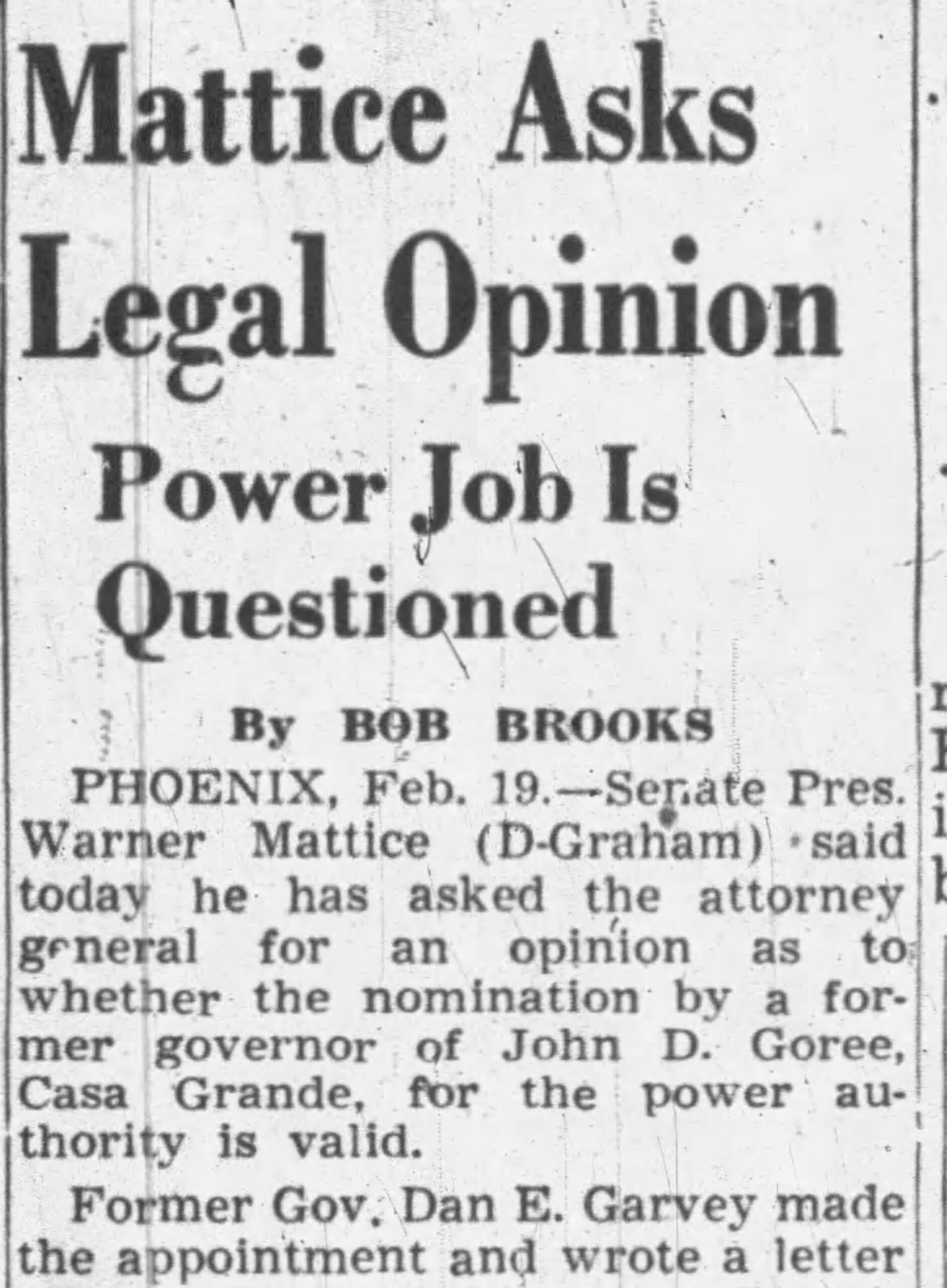
At the request of Arizona’s Republican Governor Howard Pyle, Democratic State Senator Warner B. Mattice referred the proposed 22nd Amendment to the chamber’s Suffrages and Elections Committee, as well as the Judiciary Committee, on February 5, 1951. The bill did not receive a bill number, nor was it ever heard by either committee.
Contemporaneous news articles indicate that partisan strongholds are the reason Arizona never ratified the 22nd Amendment. The Arizona Republic reported that before Governor Pyle introduced the amendment, “[t]wo Democratic governors of Arizona kept the measure from coming before the legislature.” Once the amendment was submitted to the legislature, where Democrats controlled the House and the Senate, “it got nowhere.”
Kentucky
Republican Governor Simeon Willis’s executive secretary referred the proposed amendment to the state legislature in April 1947. No further action was taken in the Democratically-controlled House and Senate.
Massachusetts
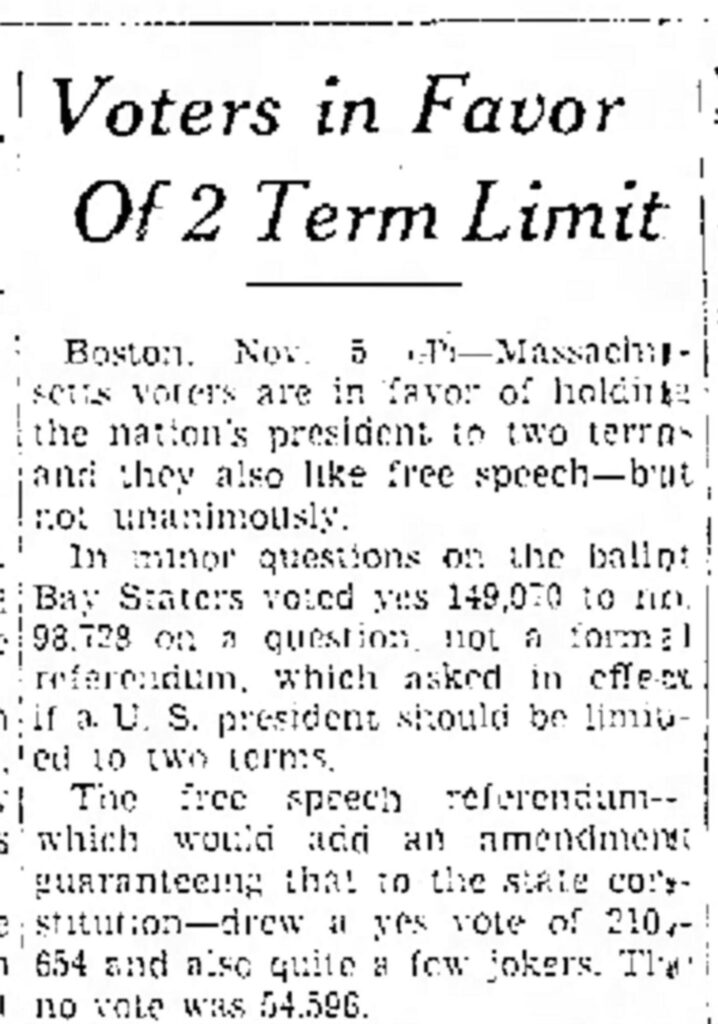
The Massachusetts legislature began debating ratification of the 22nd Amendment when the measure was sent to the states in 1947. Democratic members of the Committee on Constitutional Law wanted the voters to answer the question of ratification, while Republican members insisted the legislature ratify the proposed amendment. Democrats won the argument, and on November 2, 1948, Massachusetts voters passed Referendum Question No. 8, ”limiting the President to two terms of service” by a “decided majority.” A state newspaper described the referendum as “in effect, a public opinion poll on the proposed 22d Article of Amendment to the Constitution of the United States.” In the legislature, however, on May 31, 1949, the Senate voted to defeat a bill to ratify the amendment. Senate President Chester A. Dolan (D) casted the tie-breaking vote.
On March 23, 1950, The Boston Globe reported that the Massachusetts House passed a “proposed constitutional amendment imposing a limit of two terms for the President.” The final vote was 112 to 106, with two Democrats joining “a solid Republican bloc.” The Senate defeated the amendment on April 6, 1950 with a 19 to 15 roll call vote. Dolan, who led the fight against the proposal, was reported saying: “Don’t allow the Massachusetts Legislature to help place the country in a straight-jacket.”
On March 28, 1951, the Massachusetts legislature initiated its final efforts to ratify the 22nd Amendment. The Republican-controlled Senate voted to approve the 22nd Amendment, but on April 4, 1951, the Democratic-controlled House defeated the amendment by a 112 to 109 vote on party lines.

Oklahoma
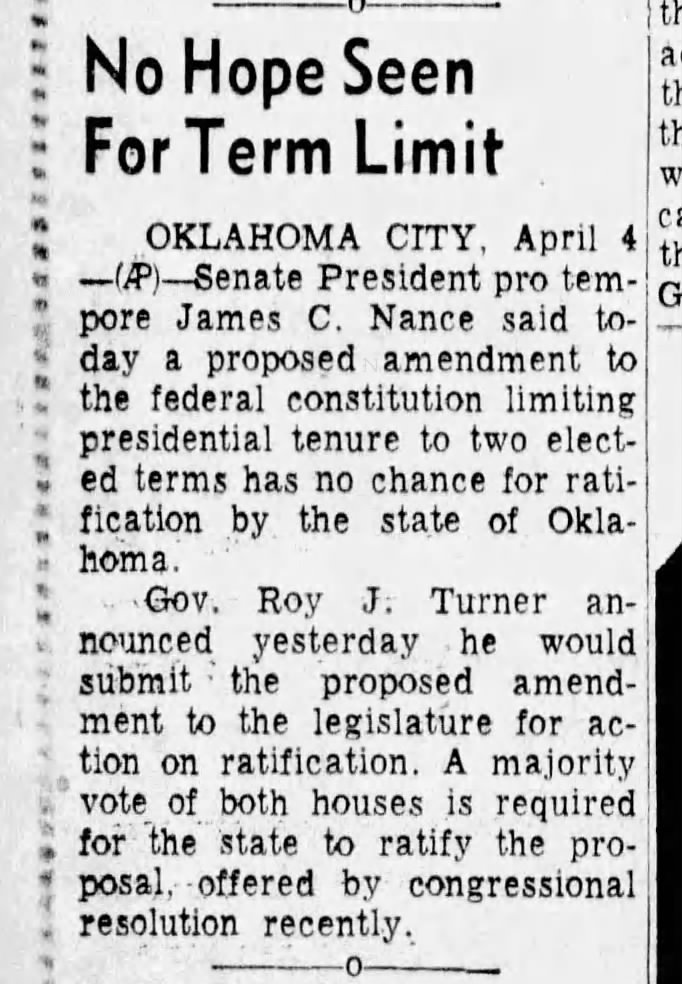
Oklahoma Democratic Governor Roy J. Turner referred the proposed amendment to the legislature in early April 1947. On April 4, 1947, Senate President pro-tempore James Nance said that ratification of the 22nd Amendment had no chance of ratification by the State of Oklahoma. Despite that pronouncement, on April 10, 1947, Republican Senator Perry Howell introduced a joint resolution to ratify the 22nd Amendment. The bill was known as SJR 18 in the Senate, and HJR 19 in the House. On April 14, 1947, the Senate killed SJR 18 by voting to postpone consideration indefinitely. Senator Howell asked that the measure “go direct to the calendar,” but his motion failed 11 to 20.


Rhode Island
On April 9, 1947, Democratic Governor John O. Pastore submitted a resolution to the Rhode Island General Assembly proposing that the state ratify the 22nd Amendment. House Floor Leader, Democrat James H. Kiernan, introduced the resolution on the same day, though “only because we have to.” The resolution went to the Judiciary Committee, of which Kiernan was chairman. No further action was taken by the committee.
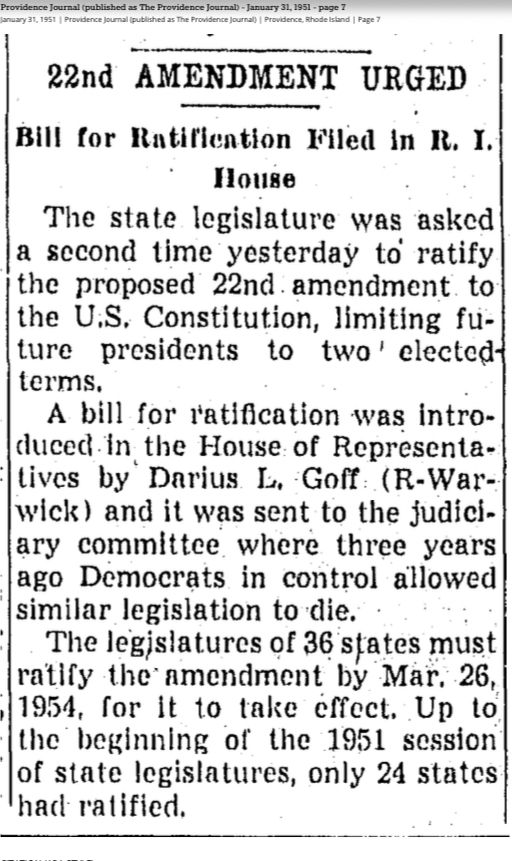
In January of 1951, Representative Darius L. Goff (R) introduced the 22nd Amendment to Rhode Island’s Democratically-controlled House. The bill was again referred to the Judiciary Committee. The Committee met on March 29, 1951, but no further action was taken. A state newspaper reported that “Democratic leaders have let it be known [that the bill] will stay [in committee], as far as they are concerned.” As predicted, no further action was taken by the committee.

Washington
The Washington State Senate voted 27 to 18 in favor of the 22nd Amendment on February 19, 1951 after “prolonged and sharp debate.” Six Democrats joined the 21 Republicans in approving the bipartisan resolution. Democratic senators argued that Senate ratification would “tie the hands of the people” and that the “framers of the Constitution had not specified any number of terms.” One senator also expressed concern that the 22nd Amendment “might force [the president] out of office during a period of crisis when his services were needed.” Republican Senator Victor Zednick led supporters of the ratification and argued that the proposed amendment had already been ratified by a “good portion of the states, both staunchly Republican and Democratic.”
The measure was then sent to the State House, where it was assigned by Democratic Speaker Charles Hodde to the Democratically-controlled Committee on Elections. Republican Floor Leader Berry Woodall introduced a proposal which would have forced the committee to release the measure for a vote of the full House membership. Despite bipartisan support, the House voted to block Woodall’s proposal. The floor leader attempted once again to force a vote on the 22nd Amendment, but Hodde ruled that Woodall’s motion was “out of order.” No further action was taken by the committee.
West Virginia
On January 16, 1951, Republican Senator Harry E. Moats introduced Senate Joint Resolution No. 1, “[p]roviding for the ratification of the proposed amendment to the Constitution of the United States and known as the Twenty-Second Amendment…” It was referred to the Committee on the Judiciary. No further action was taken.
A similar bill was introduced in the House of Delegates. Like its Senate counterpart, House Joint Resolution No. 9 was referred to the Committee on the Judiciary. Both chambers were controlled by Democrats. No further action was taken.
Gamesmanship Gives Way to Acceptance
Although efforts to ratify the 22nd Amendment in these seven states were largely thwarted by partisan gamesmanship, in most states, and at the national level, this sentiment ultimately gave way to bipartisan support. As The Arizona Republic aptly described in 1951:
“In the early progress of the amendment through state legislatures, the votes were party battles, the Republicans favoring, the Democrats opposing. But among the more recent states to ratify, this division had begun to disappear. Gradually, it was recognized that an indispensable man in the White House reflects a concept that doesn’t fit with democracy.”
Case law and state documents from several of the states that failed to ratify the 22nd Amendment confirm that the two term limit is not only enshrined in law, but has become a lasting part of our civic understanding. For example, in Hawaii, which was not a state at the time of ratification, the Office of Elections notes that the President of the United States is an office “limited to a maximum of two (2) terms.” The Rhode Island Secretary of State’s office notes that the President “is limited to serving two four-year terms.”
In 2020, a federal court in Rhode Island acknowledged that the two term tradition later codified in the 22nd Amendment was an example of “institutional forbearance” that is a guardrail of American democracy. In A.C. v. Raimondo, Rhode Island public school students brought a class action suit against state officials, alleging violations of their constitutional rights for failure to provide an “adequate civics education.” Although the court granted the state officials’ motion to dismiss the case, the opinion recognizes the importance of a civics education to the health of a democracy, explaining that “norms of political behavior” including “the unwillingness of even popular presidents like Washington, Jefferson, Jackson, and Grant to seek a third term in office before the passage of the Twenty-Second Amendment” are what “keep the American democratic system in place.” A.C. v. Raimondo, 494 F. Supp. 3d 170, 176 (D.R.I. 2020), aff’d sub nom. A.C. by Waithe v. McKee, 23 F.4th 37 (1st Cir. 2022).
In Washington, a federal court confirmed that our country’s presidential term limit, as codified in the 22nd Amendment, was a settled matter whose wisdom was “not for the courts to decide.” In Thorsted v. Gregoire, voters and congressional representatives brought an action challenging the constitutionality of various Washington state ballot access statutes, which contained term limits for members of the United States Senate and House of Representatives. The U.S. District Court in the Western District of Washington held that the statutes violated the Constitution’s qualifications clauses, explaining, “Whether congressional term limits are wise or foolish is not for the courts to decide. The nation could adopt them by amending the Constitution, as it did in limiting the President to two elected terms in the Twenty–Second Amendment, ratified in 1951. The question is whether a state may adopt them in the absence of a federal constitutional amendment.” Thorsted v. Gregoire, 841 F. Supp. 1068 (W.D. Wash. 1994), aff’d sub nom. Thorsted v. Munro, 75 F.3d 454 (9th Cir. 1996).
Despite West Virginia’s inaction on the 22nd Amendment, the state’s Supreme Court of Appeals has acknowledged that the 22nd Amendment is a constitutional term limit for the president. In State ex rel. Maloney v. McCartney, a candidate for a party’s nomination for governor brought a lawsuit challenging the right of the incumbent governor to seek a third consecutive term. The Court granted the challenger’s request, upholding a state constitutional amendment providing that a person, who has served all or any part of two consecutive terms as governor, shall be ineligible for such office during a term immediately following the second of the consecutive terms. The Court explained:
“Constitutional restrictions circumscribing the ability of incumbents to succeed themselves appear in over twenty state constitutions, and exist in the Twenty-second Amendment to the Constitution of the United States with regard to the Presidency. The universal authority is that restriction upon the succession of incumbents serves a rational public policy and that, while restrictions may deny qualified men an opportunity to serve, as a general rule the over-all health of the body politic is enhanced by limitations on continuous tenure. State ex rel. Maloney v. McCartney, 223 S.E.2d 607, 611 (W. Va. 1976).”
These facts confirm what the public already knows: that the 22nd Amendment’s core mandate—that a president may not be elected to more than two terms in office—is alive and well. Even though nine states have not ratified the amendment, it is the law of the land in all 50 states, and the general public’s understanding of American democracy is deeply tied to the 22nd Amendment’s restrictions on presidential power.