Fifteen companies have contributed to at least three of Trump’s pet projects

Meta, Amazon, Coinbase and Google are the top contributors to Trump's pet projects
- Fifteen companies have contributed to three or more of Trump’s pet projects, exemplifying corporate capitulation to Trump’s style of pay-to-play politics.
- All of the top 15 corporate contributors have business before the government or want something from Trump.
- Thirteen out of 15 top contributors have met with Trump or joined him on travel or at events—one of many valuable benefits granted to the companies that have indulged Trump’s intense interest in these projects.
President Donald Trump’s second term has been characterized by unprecedented corruption, including corporate capitulation to Trump’s style of pay-to-play politics. Even more than during his first term, the president has rewarded corporations supporting him with access, influence and even support and promotion, while directly targeting companies he views as adversaries through his Justice Department and on social media. At the same time, Trump has enabled corporations to seek influence with his administration by opening additional avenues to support pet projects unrelated to the core duties of the presidency—including his White House ballroom, inauguration, library and grandiose, politicized celebrations for America’s 250th anniversary.
Corporations have indulged Trump in his fixation on these projects, spending millions of dollars funding them while seeking his favor and wins from his administration. Fifteen companies have contributed to three or more of these projects, according to a CREW analysis of disclosure documents, news reports, press releases and other sources.
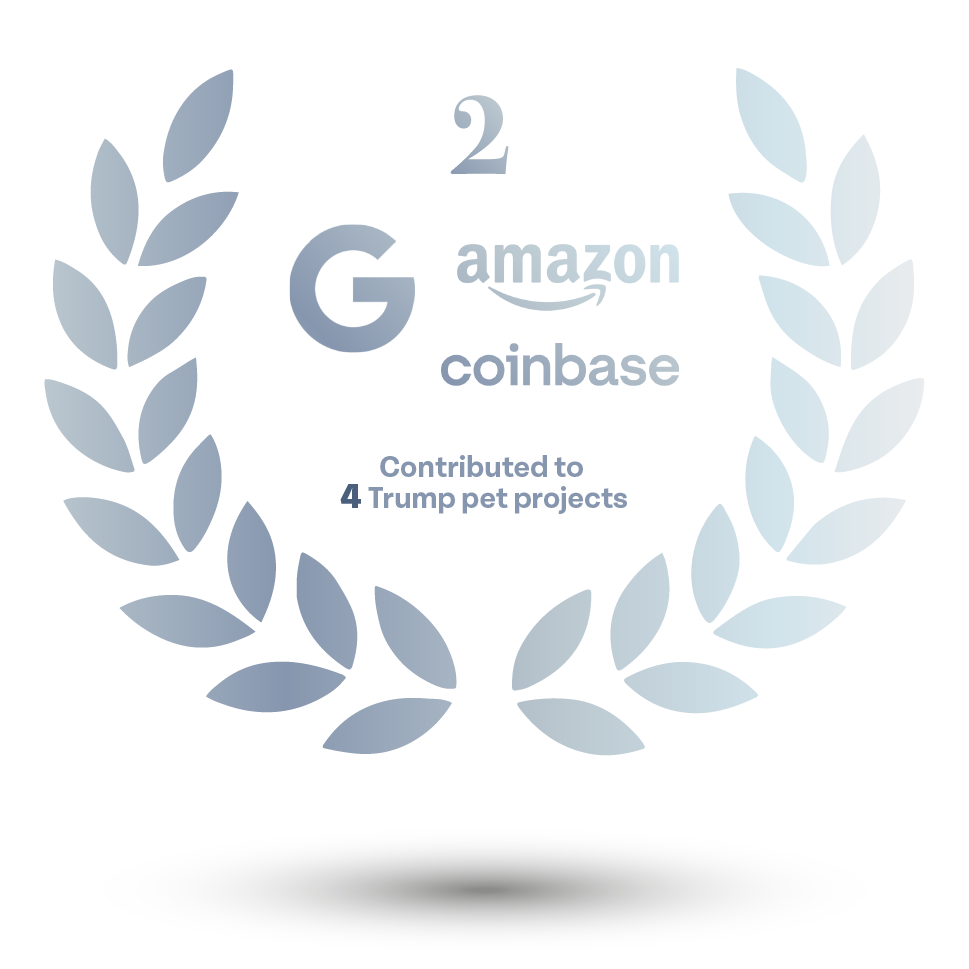
Meta has donated to the greatest number of these projects, with contributions to six. Amazon, Coinbase and Google/Youtube contributed to four. RTX (formerly known as Raytheon), Lockheed Martin, Mastercard, Exiger, Scotts Miracle-Gro, Altria Group, BlackRock, Nvidia, Palantir, Comcast, and Chevron donated to three.



CREW tracked hundreds of donations to 10 projects to which Trump has devoted unusual attention or for which fundraising has been well outside of established presidential norms.
Trump is treating these projects differently than presidents have treated their signature initiatives in the past, making the projects more about his own legacy and image—by putting his own name on them, soliciting corporate funding rather than going through the congressional appropriations process and moving money freely between them.
What do corporate donors to Trump projects want?
All of the top 15 corporate contributors to Trump’s pet projects have business before the government or want something from Trump. Twelve (RTX, Palantir, BlackRock, Coinbase, Meta, Nvidia, Amazon, Exiger, Lockheed Martin, Chevron, Comcast, and Google/Youtube) have government contracts. At least nine (Chevron, Meta, Amazon, BlackRock, Coinbase, Google/Youtube, Lockheed Martin, RTX and Nvidia) have faced enforcement actions from the government in recent years, some of which are ongoing.
In addition to seeking government contracts or avoiding regulatory enforcement, top corporate donors to Trump’s pet projects have varied and potentially lucrative interests in Trump administration actions, for example:
- Altria Group advocated against regulation of vapes and e-cigarettes during a meeting with Trump, alongside another rival tobacco company.
- Mastercard has an interest in defeating Trump’s effort to cap credit card interest rates.
- Chevron lobbied extensively to protect its investments in Venezuelan oil.
- The Trump administration has considered investing in Lockheed Martin and Palantir.
- The CEO of Scotts Miracle-Gro advocated directly to Trump for marijuana rescheduling.
What do corporate funders to Trump projects get?
When asked, Coinbase’s COO seemed to agree that their donation to Trump’s White House ballroom was to “keep good relations with the White House.” An executive at NBC Universal, a subsidiary of Comcast, justified the company’s donation to the ballroom on similar grounds: “If we have to name a ride after him at Universal Studios, that’s fine too, as long as it means they leave us alone.” From VIP invitations, to private meetings with the president, to promotion on social media, to policy wins—top corporate funders have benefited in countless ways from opportunities to curry favor and gain influence.
The Trump administration and its allies have incentivized donating to Trump’s pet projects by granting special access to donors, including by throwing a dinner for donors to the White House ballroom, offering a “VIP experience” for America 250 donors at the 2025 military parade and invitations to a reception for million dollar donors to Freedom 250.
Use the next/previous buttons to view a series of images and captions.
-

Meta CEO Mark Zuckerberg and Trump
-
Google President and Chief Investment Officer Ruth Porat, Amazon CEO Andy Jassy, BlackRock CEO Larry Fink, Nvidia CEO Jensen Huang and Trump at a U.S.-Saudi Investment Forum
-
Coinbase CEO Brian Armstrong and Mastercard CEO Michael Miebach attend and respond to Trump’s GENIUS Act signing
-
Nvidia CEO Jensen Huang and Trump
But even beyond these events, the corporations who have donated to his projects have gained valuable access to Trump. Executives from 13 out of the top 15 corporate donors to his pet projects have met with Trump or joined him on travel or at events. Executives from Chevron, Coinbase, Meta, Amazon, Scotts Miracle-Gro, Altria, Lockheed Martin, Google, and RTX have all had private meetings with Trump. Palantir, Nvidia, Amazon, BlackRock and Google joined him at an event in Saudi Arabia during a trip to the Middle East, and BlackRock, Nvidia, Meta and Mastercard joined him on a trip to China.
Even in an administration that has generally focused on deregulation, gutting consumer protections, lowering corporate taxes and other corporate-friendly policies, some of these top donors to Trump’s pet projects have been singled out for notable wins. For example:
- Trump posted on Truth Social praising Palantir’s “great war fighting capabilities and equipment,” temporarily boosting the company’s stock price.
- As Lockheed Martin’s CEO put it recently, Trump’s administration has been a “golden opportunity” for the company—which is the Pentagon’s biggest contractor and has received more than $43 billion in new or increased government contracts in the last seven months.
- BlackRock has been enlisted to assist with Ukraine’s recovery plan, from which it may stand to profit.
- Trump reversed decades of foreign policy precedent by allowing Nvidia to sell chips to China.
Trump’s second term has presented corporations with numerous avenues to direct money to the president’s pet projects. For the companies that can afford to make millions in donations, they are rewarded with support, access and influence. That is the textbook definition of corruption—and these companies are choosing not only to engage in it, but to triple down.