“Gold Card” visas make pay-to-play an official policy under Trump

Donate millions of dollars to Freedom 250 to receive special access to the president. Be one of the world’s largest buyers of the $TRUMP memecoin to have lunch at Mar-a-Lago or dinner at the president’s members-only golf club. Pay more than a billion dollars for a permanent seat on President Donald Trump’s Board of Peace.
Pay-to-play has long been a feature of the Trump administration. And now it is becoming the administration’s practice in the immigration system with the president’s new Gold Card visa: a visa program to allow immigrants who can afford to make a $1 million payment (or who are sponsored by a corporation or similar entity that makes a $2 million payment) to the Department of Commerce’s “gift” account to “receive U.S. residency in record time.” Despite the Department of Homeland Security’s primary responsibility over immigration, the president inexplicably directed Secretary of Commerce Howard Lutnick to spearhead this immigration initiative, which purportedly allows individuals who can afford it to be eligible for certain types of employment-based visas without having to satisfy USCIS’s usual extraordinary or exceptional ability standards.
The administration’s attempt to establish a visa program without Congress’s authorization, direct payments to Commerce for expedited services at a different federal agency, treat those payments as “gifts” rather than fees and use mere access to wealth as a substitute for established immigration eligibility requirements raises numerous legal questions. But beyond the apparent lack of a legal basis for the program, Gold Card visas present many practical and equity concerns.
Crucially, the administration is launching this effort to remake the immigration system in its wealth-oriented image as it attempts to restrict legal pathways for others, including requiring a $100,000 payment as a condition for an H-1B nonimmigrant visa and openly attacking the birthright citizenship guaranteed by the Constitution. The Gold Card program would allow the administration to prioritize corporate and wealthy interests without considering the impact on or benefit to the rest of the country. It would create opportunities for fraud and abuse by allowing foreign individuals or corporations to make substantial payments in exchange for an expedited government service. And it would do so at the same time that the administration has claimed that United States Citizenship and Immigration Services screening and vetting procedures are “wholly inadequate.”
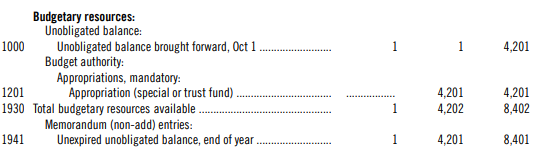
The Gold Card program also would turn the usually modest Commerce gift account—which typically contains no more than $1 million in private donations to support Commerce’s work—into a largely unbounded slush fund. Indeed, the president’s recent budget request projects that in each of the next two fiscal years the gift account will receive more than $4.2 billion in receipts, which would result in $8.4 billion in available resources by the end of fiscal year 2027. This extraordinary increase would approach the Department’s entire $9.2 billion discretionary funding request for fiscal year 2027.

These efforts to prioritize wealth in the immigration system and take in money from private interests raise grave corruption and transparency concerns. Below we explain in detail what the administration has shared (or not shared) about the Gold Card program, the concerns raised by this potentially significant influx of private cash and—regardless of whether the program withstands ongoing litigation—what steps Congress should take to mitigate and conduct rigorous oversight of the administration’s unilateral attempt to monetize entry to the United States.
Contents
- What is a Gold Card?
- The Gold Card payments: Isn’t more money for government programs a good thing?
- What can Congress do?
What is a Gold Card?
Each year, about 140,000 employment-based immigrant visas are available for five different preference categories. For each category, Congress has set up both certain requirements the applicant must satisfy and an annual cap on the number of available visas.
The Gold Card program purports to create a modified, expedited track for two employment-based categories: EB-1A visas, also known as “Einstein” visas, for individuals with extraordinary ability in the sciences, arts, education, business or athletics, and EB-2 visas, for individuals with an employer sponsor (or who receive a national interest waiver) whose exceptional ability in certain areas will “substantially benefit” the national economy, cultural or educational interests or welfare. Ordinarily, the government issues employment-based immigrant visas in the order in which the underlying petitions are filed, and the annual limit on the number of EB-1 and EB-2 visas typically is reached before the end of the fiscal year.
To begin, Gold Card applications are sent not to the adjudicators who review the tens of thousands of other EB-1 and EB-2 petitions but, rather, to a separate set of USCIS employees whose “primary duty” is to adjudicate Gold Card filings. Access to this distinct process may prove critical given the annual caps on the issuance of EB-1 and EB-2 visas.
Moreover, Gold Card applicants may substitute wealth for the typical, rigorous evidentiary standards for proving “extraordinary” or “exceptional” ability. Extraordinary ability requires “a level of expertise indicating that the individual is one of that small percentage who have risen to the very top of the field of endeavor.” It’s called the Einstein visa for a reason: applicants ordinarily must provide evidence of a one-time achievement—which USCIS explains can be satisfied by winning, for example, a Pulitzer prize, an Oscar or an Olympic medal—or submit evidence of several other factors, ranging from published material, to leading roles in distinguished organizations, to commercial success. Even though this visa does not require the applicant to have a job offer in the United States, they must provide “clear evidence” that they will continue to work in their field.
Exceptional ability also carries a high standard, defined as “a degree of expertise significantly above that ordinarily encountered in the sciences, arts, or business.” An applicant generally proves this expertise with documentation of an advanced degree and several other factors, such as a decade of practice, a license to practice the particular profession, and recognition for achievements and contributions in their field. Typically, the applicant must show that their ability will substantially benefit the United States, and file a labor certification and submit evidence of a job offer unless they can show that it would be in the interest of the United States to waive those requirements (the national interest waiver).
A Gold Card applicant faces none of these hurdles. Once a Gold Card applicant in either category pays a $15,000 “processing” fee to the Department of Homeland Security and commits to making the Gold Card payment to the Commerce gift account, USCIS vets the applicant and begins expedited processing of their application.
Once they make the $1 million (or, for a corporate sponsor, $2 million) payment to Commerce, the applicant is eligible for an EB-1A or EB-2 visa. No need to win an Olympic medal, demonstrate past success or show that they have a job offer or will continue to work in the United States. According to the administration, wealth—regardless of how it is obtained—serves as an adequate substitute: the government simply “treat[s] the gift . . . as evidence of” exceptional business ability for EB-1A visa applicants, and benefit to the United States and eligibility for a national-interest waiver for EB-2 visa applicants.
This is not the only time that the administration has emphasized wealth in the immigration context. In January, the administration paused all visa issuances to applicants from 75 countries that it labeled “high-risk.” The administration’s risk analysis hinged solely on its claims that individuals from those countries might rely on public benefits, making clear the administration’s desire to facilitate or restrict immigration based on an applicant’s affluence, or lack thereof. The CATO Institute has referred to this 75-country ban—which may result in the government accepting money for immigration applications it does not plan to adjudicate—as part of a “massive fraud” by the federal government.
Moreover, in focusing on wealth, both the Gold Card program and the visa pause fail to meaningfully evaluate benefit to the United States. The Gold Card, for example, may allow wealthy applicants to receive visas that count toward the annual limit while talented engineers, researchers and scientists—including those who conduct stem-cell or cancer research, design devices and systems for sleep and pain management, monitor water quality and develop water treatment applications and support treatment for children affected by trauma and violence, but who cannot afford to make a seven-figure payment—remain in the queue.
And in implementing the visa pause, the administration apparently did not consider the substantial benefit visa applicants from those countries can and historically have provided to the United States. For example, in fiscal year 2024 Department of State data showed that petitioners from 43 of the 75 countries subject to the pause accounted for more than a quarter of the EB-1 preference visas issued. And petitioners from 51 of the countries accounted for nearly half of the EB-2 preference visas issued. In other words, despite historically relying on individuals from these countries to bring their “extraordinary” and “exceptional” talent and expertise to the United States, the federal government now has categorically barred anyone from these countries from doing so.
The Gold Card payments: Isn’t more money for government programs a good thing?
In many instances, Congress allows agencies to accept and use private donations to support programs that benefit the American people. This includes the use of donated funds to facilitate after-school programs, affordable housing and disaster responses, support the national parks and serve public health initiatives.
But even when Congress allows an agency to receive and spend private gifts or payments for these or other public purposes, there are risks of fraud, waste or abuse. Private funding may have strings attached, raise organizational or personal conflicts of interest or come from a prohibited source (such as a country subject to sanctions). And a significant influx of private cash brings with it both an increased need for guardrails in reviewing and spending incoming amounts and diminished congressional control.
A separate employment-based visa established by Congress, known as the EB-5 or immigrant investor visa, highlights the risks for fraud and abuse inherent in a wealth-based immigration system. Congress designed the EB-5 program to provide economic benefits in the United States, making an individual eligible to apply for a visa if they invest at least $1,050,000 (or $800,000 in certain areas) in either an enterprise that directly creates or preserves at least 10 permanent full-time jobs for U.S. workers, or in a regional center approved by USCIS to pool investments to facilitate job creation, capital investments and other economic growth in a certain geographic area.
This investment program, which aims to spur development in local communities, stands in stark contrast to the president’s attempt through the Gold Card program to allow foreign interests to pay into a slush fund that may or may not benefit the American people. But even this congressionally established structure has been fraught with waste, abuse and national security issues, previewing enhanced risks for the presidentially created Gold Card program.
Examples of fraud and national security risks: The EB-5 program
Over the years, both the legislative and executive branches have identified enhanced fraud and national security risks with the EB-5 investor program, including:
- Incentives for petitioners to report inaccurate information about the source of their funds (such as when the source of funds is from illicit sources such as drug or human trafficking or money laundering).
- Difficulty verifying the source of immigrant investor funds (USCIS denied an EB-5 petition, for example, because the petitioner did not report potential financial connections to brothels in China).
- Submission of counterfeit financial information or other document fraud (which government officials may not have means, access or authority to verify in foreign countries).
- Identity fraud (using someone else’s documents or personal information).
- Perception of special treatment or appearance of favoritism for those with special access to DHS leadership (one USCIS director allegedly created special processes to accommodate certain petitioners, which could increase the likelihood that fraud or criminal ties are not identified in the review process).
- Exploitation of the EB-5 program to steal intellectual property, gain influence in American companies or conduct activities that could pose a national security risk (the Government Accountability Office reported that between 2016 through 2021, EB-5 national security concerns generally increased).
In response to these concerns, Congress put in place, and the agencies involved implemented, several safeguards. Under the current system for EB-5 immigrant investor visas:
- A petitioner must show that the funds “were obtained from a lawful source and through lawful means,” an evidentiary burden that USCIS takes seriously.
- DHS administers an EB-5 Integrity Fund that, among other activities, provides support for DHS to conduct investigations outside of the United States, ensure a petitioner’s investment funds are from a lawful source and detect and investigate fraud.
- Several agencies—DHS, the Department of State, the Securities and Exchange Commission, the Federal Bureau of Investigation and the Department of the Treasury’s Committee on Foreign Investment in the United States—review applications, evaluate compliance with program requirements, investigate fraud and national security concerns or conduct security checks.
- USCIS’s Fraud Detection and National Security Directorate processes internal fraud and national security referrals.
- DHS ethics guidance applies to all DHS and USCIS employees and contractors involved in policymaking, evaluation, or review of the program or the adjudication of any EB-5-related petition.
- DHS denies or revokes the approval of petitions based on fraud or national security concerns.
These important compliance measures, however, come with a cost. For the EB-5 Integrity Fund, for example, the administration projected that it would spend $12 million in fiscal year 2026, which includes support for 35 full-time equivalent employees. Congress has not established a similar “integrity fund” for the Gold Card program, which by its nature poses similar or greater fraud or national security risks.
Gold Card visa risks
Like an EB-5 petitioner, a Gold Card applicant must identify the source and provide evidence of the lawfulness of the funds they will use for their payment. A Gold Card can be revoked for “national security and significant criminal risks.” And generally applicable criminal laws, such as the conflict of interest statute, continue to govern the conduct of the employees who process any applications or payments.
But the Gold Card program presents unique risks while lacking the statutory guardrails Congress set up for the similar EB-5 program. To begin, USCIS collects documentation on the source and lawfulness of the funds, but it is the Department of Commerce—an agency that lacks both the expertise in and the authority to enforce immigration laws—that receives the payment. The Trumpcard.gov website does not make clear how or whether USCIS and Commerce will work together to detect fraud, evaluate national security risks or prevent conflicts of interest and undue influence. This apparent lack of coordination enhances the risks revealed by the EB-5 program: incentives for document or identity fraud, challenges verifying the source of funds and the potential for favoritism or exploitation of the program.
For example, over the past year lawmakers have repeatedly asked Commerce to investigate TP-Link, a company that manufactures routers and other network equipment. Members of Congress have highlighted the company’s ties to the People’s Republic of China and alleged security risks, while TP-Link also reportedly has been the subject of a Department of Justice criminal antitrust investigation for predatory pricing and a Federal Trade Commission investigation for allegedly trying to conceal its connections to China. Now, however, the company’s founder and CEO has applied for a Gold Card. Neither USCIS nor Commerce has issued regulations that would explain how any ongoing investigations at or other security risks identified by a federal agency will affect their processes for reviewing the CEO’s application or payment to the Department of Commerce gift account.
Without proper statutory or administrative controls, the Gold Card program could allow foreign interests to buy expedited entry to the United States notwithstanding national security risks. And these oversight concerns do not end when the Department of Commerce receives an applicant’s $1 or $2 million payment.
A Commerce slush fund
Usually, agencies tell Congress how much money they need for the upcoming fiscal year in their budget requests. Using that information, Congress can determine how much to appropriate for, establish or redefine the contours of, or place restrictions on a program. For high-risk or high-dollar-value initiatives, Congress also may decide to require inspector general review or, as it did for funding for Ukraine or pandemic relief, establish a special inspector general to monitor the use of the funds.
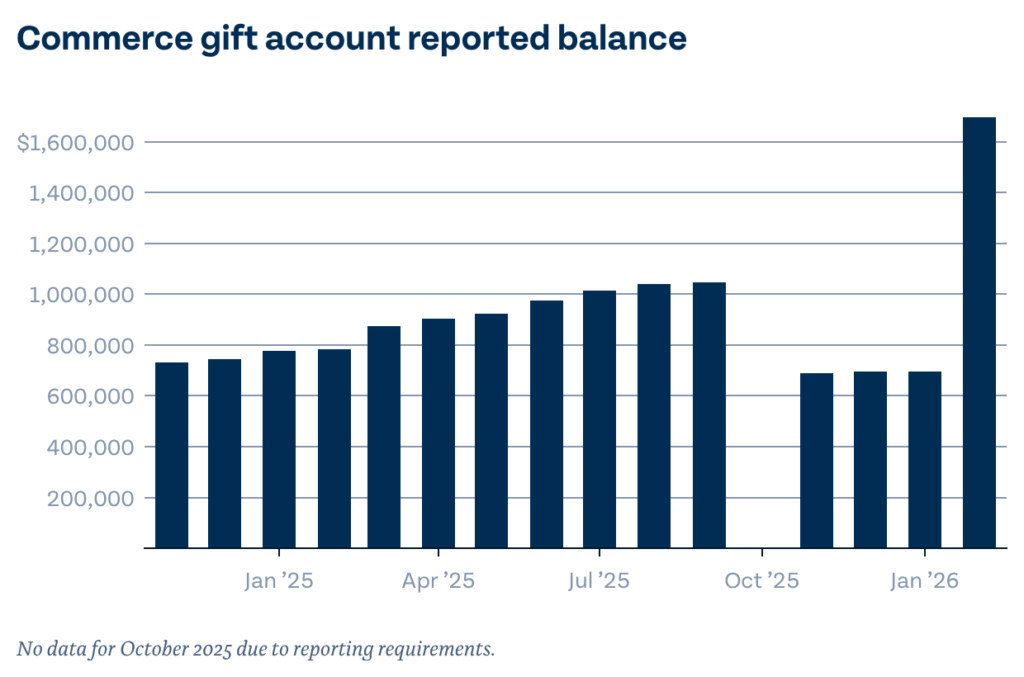
For this fiscal year, the president told Congress that Commerce expected to receive approximately $1 million in private gifts (which is generally consistent with the balance of the Commerce gift account for the past several fiscal years). But since the announcement of the Gold Card program, that estimate has skyrocketed. The president’s fiscal year 2027 budget request projects that in this and the following fiscal year the Commerce gift account will receive more than $4.2 billion, accumulating a balance of $8.4 billion by the end of fiscal year 2027. Because Gold Card applicants cannot put any limits on what their payments can be used for, by the end of the next fiscal year this program could give Secretary Lutnick and the Department of Commerce a bucket of unrestricted cash approximately 8,400 times larger than the typical Commerce gift account balance.
As of April 28, 59 applicants had submitted their Gold Card applications to USCIS, and Commerce Secretary Lutnick recently confirmed that one person has been approved. Department of Commerce spending data suggests that this applicant—whose identity is not publicly known—has made the $1 million payment: between January and February of this year, the Commerce gift account balance jumped by exactly that amount.

Unbounded access to such a substantial amount of cash raises many concerns. In addition to the issues presented above about the lawfulness of the source of the funds, and a lack of transparency regarding individual donations to the Commerce gift account, how will the Department of Commerce ensure that the acceptance and use of the funds complies with all relevant laws and agency requirements? Does the Department have the capacity and willingness to conduct those necessary reviews for all incoming amounts? Commerce is permitted to use these funds only for “aiding or facilitating” the Department’s work. What, exactly, will the Department spend the money on?
Beyond these concerns about implementation, increased executive control over spending places government programs designed and funded through careful, bipartisan congressional negotiations at the whims of one person or agency. An unexpected influx of cash may give the president additional power to reward certain states, groups or individuals while punishing others. And without express controls on this funding, the president may use the stream of incoming amounts as an avenue to implement policies and priorities that conflict with, or that Congress explicitly sought to prohibit, through bipartisan appropriations acts.
What can Congress do?
A nonprofit and several individuals already have asked a court to declare the Gold Card program unlawful and prevent the administration from implementing it. But lawsuits take time, and as evidenced by the $1 million payment already made to the Commerce gift account, the risks detailed above are present now.
At the very least, the significant legal concerns and the potential for fraud, abuse, national security issues, corruption and unmonitored spending in the Gold Card program warrants immediate and significant oversight. Without legitimizing the administration’s efforts, Congress can ask the agencies implementing this program—Commerce, DHS and State—to explain their policies, procedures and any interagency efforts to address these concerns. Congress also should ask independent bodies, including the relevant inspectors general and GAO, to review the effectiveness of these processes for determining the legitimacy and lawfulness of incoming funds, the government’s proposed use of payments to the Commerce gift account and the legality of the Gold Card program’s general structure.
From the funding perspective, the Gold Card is just one example of many executive branch attempts to generate largely unrestricted slush funds. Among others, the administration has discussed plans for the government to create or control a sovereign wealth fund, government shares of Nvidia and AMD proceeds, donations for a White House ballroom, proceeds from the sale of Venezuelan oil and the high-dollar contributions to Freedom 250 and Board of Peace membership fees mentioned above. Experts already have suggested many governmentwide reforms—such as limits on and additional transparency for donations—to prevent these attempts to circumvent congressional controls. And for gift authorities, as early as 1980 GAO recommended governmentwide guidance that would require federal agencies to provide additional details on gift funds in their budget submissions and establish universal criteria for soliciting, receiving and using donations. These recommendations remain particularly salient with regard to the Gold Card program, which may allow Commerce to add several billion dollars from foreign sources to its gift account. In addition to the immediate oversight required for the Gold Card program, Congress should prioritize these long-term reforms to protect its power of the purse.
Lauren Bingham contributed to this piece.
Screenshot of Trump Gold Card from trumpcard.gov