Trump foreign property income is set to explode in his second term

Donald Trump is set to see enormous, unprecedented income from his overseas real estate developments in his second term, estimated to exceed $400 million and likely over $430 million, according to a CREW analysis of his financial disclosure data dating back to 2014. This projected income would mark an enormous yearly increase from past revenue, including the over $140 million Trump made from overseas developments during his first term. New projects in the Middle East and elsewhere are fueling an explosion in foreign income for the Trump Organization, from which he has refused to divest in both of his presidential terms. In total, CREW estimates that Trump has reported more than $430 million through his developments abroad over ten years of filings as a candidate and officeholder. He is set to roughly double that amount during the four year period of his second term if his income remains at 2024 levels. But far from slowing down or stagnating, Trump’s foreign business, and the corruption concerns it raises, appear to be accelerating daily.
During his first term, Trump’s income from his foreign properties is estimated to have totaled at least $149 million and possibly more than $186 million. That total already marked a drastic departure from any other modern presidency—White House occupants of both parties have taken seriously the need to divest from business interests while in office—and yet it appears set to pale in comparison to his expected income in his second term, based on his reported 2024 income and the slew of new developments announced since 2024. In 2024 alone, Trump’s foreign income hit a record high of at least $101 million, a single year total that amounts to over half of his total foreign income during the four years of his first term. The upper estimate of that income—most totals are reported in ranges on financial disclosures—is almost $109 million, over 60% larger than previous annual highs, and more than doubling 2023’s total. Even if his income remained at 2024 levels throughout his second term, it would more than double his first term income from foreign developments. As is, with multiple projects not yet reporting income and new deals still being announced, this estimate is almost certainly conservative.
While the Trump Organization surely raked in tens of millions of dollars from foreign deals, including multiple new ones, during his first year back in office, Trump won’t have to file a financial disclosure reporting this 2025 revenue until later this year.
Meanwhile, Trump is increasingly enmeshing his personal financial interests with foreign affairs amid a roiling international economic landscape. His overseas revenues are a daily reminder of the unfettered conflicts of interest that this administration seeks to normalize and the avenues through which foreign governments attempt to influence the president on a number of issues, from tariffs to crypto-currency. Left in the lurch, regular Americans are left carrying the economic burden of Trump’s bargaining chips.
Trump currently has ten open overseas developments, with at least 22 in development—at least five of which have been announced since his inauguration. Some—such as those in Qatar and Saudi Arabia—stretch or break his voluntary ethics pledge not to enter into business with foreign governments.
Trump was first required to file financial disclosures in 2015, and this decade-long picture of Trump’s finances gives important insights into his extensive history of making money from office. Most disturbing, though, is the tidal wave of money Trump reported receiving in 2024. He reported income of at least $101 million and up to nearly $109 million from his foreign businesses that year, a shocking increase from 2023, when he listed between about $44 million and $49 million. While he was not president when the deals fueling this income went through, they came about while he was first the frontrunner, then Republican nominee and ultimate winner, of the 2024 election. Those deals are almost certain to provide millions in annual foreign income for the company he has refused to divest from.
One of the lessons demonstrated by Trump’s financial disclosure data is that his foreign income correlates to his time in the White House, or his likelihood of returning. When Trump came into office in 2017, foreign income hit a new high, with a minimum estimate that year of over $45 million, nearly a one-third increase from previous minimums, and a maximum estimate of over $66 million, a new estimated high. However, some of his pre-office income only has the amount marked as “Over $5 million,” leaving maximum estimates arbitrary.
Trump’s income from overseas developments from 2014 through 2024 has totaled at least $430 million, and possibly over $530 million. The massive income over the last decade-plus was led by properties in the United Kingdom, Ireland and the United Arab Emirates. The UK and Ireland, where Trump owns properties outright, have long led Trump’s foreign income: the UK brought in over $216 million over the eleven-year period from Trump’s Aberdeen and Turnberry golf course and hotel properties, while Ireland, home to Trump’s Doonbeg hotel and golf course, grossed over $118 million. The UAE, in contrast, was not a notable source of income until 2024. Then, Trump’s Emirati income skyrocketed by more than ten-fold—from nearly $2.7 million in 2023 to more than $27 million in 2024—for a total estimate of at least $34 million to likely more than $39 million.
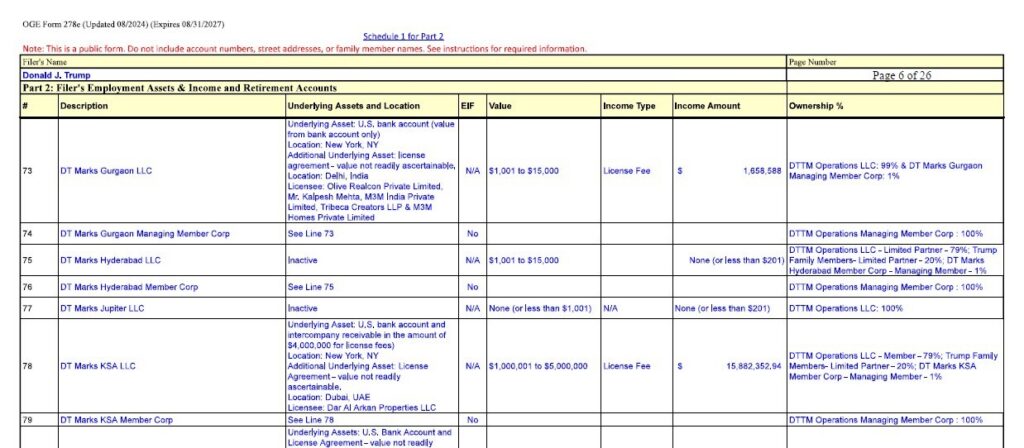
This enormous spike in income from the UAE is thanks to huge new licensing deals, grossing over $20 million in fees, according to Trump’s most recent filing. Both deals are with Dar Global, the international arm of a Saudi Arabian real-estate company with which the Trump Organization has a long history, including working on overseas developments together since 2022. Dar Global also recently opened offices in Trump Tower in New York. They have officially announced seven development projects with the Trump Organization around the Arabian Peninsula, plus a crypto-tied project in the Maldives and hints at a project in Greece. Trump’s financial disclosures list a total of more than $26 million from Dar Global partnerships, starting in 2023. This total is from the licensing fees for only two properties: developments in Dubai, UAE and Muscat, Oman, that have not yet opened. This means the sum is just the tip of the iceberg: tens of millions of dollars are projected to come in from other properties and future management fees, and multiple new projects have been announced in the last year. And there are no signs of the Trump Organization slowing its Middle East business. Both Dar Global and Saudi-government-owned projects have recently hinted at forthcoming deals with the Trump Organization.
India, too—long a bastion of Trump’s foreign business empire—was the locus for a huge jump in foreign income for Trump. In his financial disclosure data for 2024, Trump reported a new $10 million influx of development fees for an as-yet-unnamed project in Mumbai with Reliance 4IR Realty Development, a subsidiary of Reliance Industries. Last May, during Trump’s visit to Qatar, Reliance chairman Mukesh Ambani, India’s richest person, attended a state dinner in Trump’s honor. Months later, after the raid in Venezuela to capture President Nicolás Maduro, Ambani’s company entered talks with the US to secure a permit to buy Venezuelan oil, a bid that it won last week.
In all, Trump has two projects open in India, and eight in development—six of which were reported to local media the day after Trump’s 2024 election victory. India now has the most Trump projects in development of any foreign nation by far. Most of these deals have not apparently shown up on Trump’s financial disclosures yet. Even with just the unnamed Mumbai project reporting significant income in 2024, Trump’s income from Indian developments that year was over fifteen times that of 2023, and more than double previous high estimates.
While the UAE and India are the most dramatic examples, they are by no means the only countries where Trump’s income saw a marked increase in 2024. The United Kingdom and Ireland, both home to relatively long-established Trump properties, saw reported income jump from 2023 to 2024. Income from Trump’s two Scottish properties rose more than 50%, by approximately $13 million, to surpass their previous record high from Trump’s first term, and Doonbeg in Ireland jumped more than one third. However, despite a rise in reported income at both Scottish properties in 2024, with record sales at Turnberry that year, both properties reported yet another year of net losses.
Trump’s foreign business interests have raised eyebrows and legal concerns during both of his administrations. He famously failed to divest from his business interests in his first term, instead setting out ethics guidelines for the business that included a ban on new foreign deals. In his second term, he laid out a much weaker ethics pledge, without a ban on foreign deals, and the Trump Organization’s adherence to it has been questionable at best. Several of his overseas deals have also faced legal and ethical criticisms. But with nearly a quarter of House Republicans patronizing his domestic businesses and hundreds of thousands of dollars coming in from Republican party institutions, the party not only failed to curb Trump’s profiteering, but has fully embraced it.
A Trump development may be a bargaining chip for foreign countries negotiating with the Trump administration, particularly as Trump keeps the international economy in flux with threats of enormous tariffs. His foreign developments involve partnerships with over fifteen foreign companies, some with direct ties to foreign governments, posing serious questions about what conflicts of interest could be at play as Trump makes foreign policy decisions. The Vietnamese government has moved to fast-track a Trump project despite legal objections. In October 2025, Trump was recorded on a hot mic apparently discussing Trump Organization business with Indonesia’s president. In Serbia, too, officials used extraordinary measures and alleged fraud to move a Trump project along, facing opposition by mass protests and leading to the arrest of the country’s culture minister. The project has now apparently collapsed with the withdrawal of Affinity Global Development, which is linked to Jared Kushner’s Affinity Partners, a rare instance of successful accountability tied to the Trump Organization.
Trump’s opaque financial disclosures leave dozens of open questions. Some properties have wildly fluctuating incomes, and some announced projects haven’t shown up on the disclosures at all yet. For example, some entities, like THC Rio Manager LLC (an entity apparently related to an ill-fated development in Brazil that the Trump Org eventually pulled out of), are only sporadically reported, and others, like the entity holding Trump’s estate in French St. Martin, list incomes that vary by multiple orders of magnitude from year to year. Still more entities, like those related to Trump’s golf course in Lido, Indonesia, have inexplicably seemed to stop receiving income. Even when planned properties don’t get built, Trump regularly comes out ahead, retaining licensing fees regardless of whether projects materialize.
Regardless of these anomalies and open questions, the tangled web and huge scale of Trump’s foreign revenues are powerful reminders of why presidential divestment and disclosure of financial entanglements are vital norms. The American people should not have to wonder whether the president is putting their interests, or his own financial interests first when he negotiates with foreign countries. Unfortunately, Trump’s failure to divest from his businesses—and instead his dramatic expansion of foreign developments and income—make those questions not only necessary but urgent.