Report suggests energy interests sought to secretly support EPA Administrator’s campaign
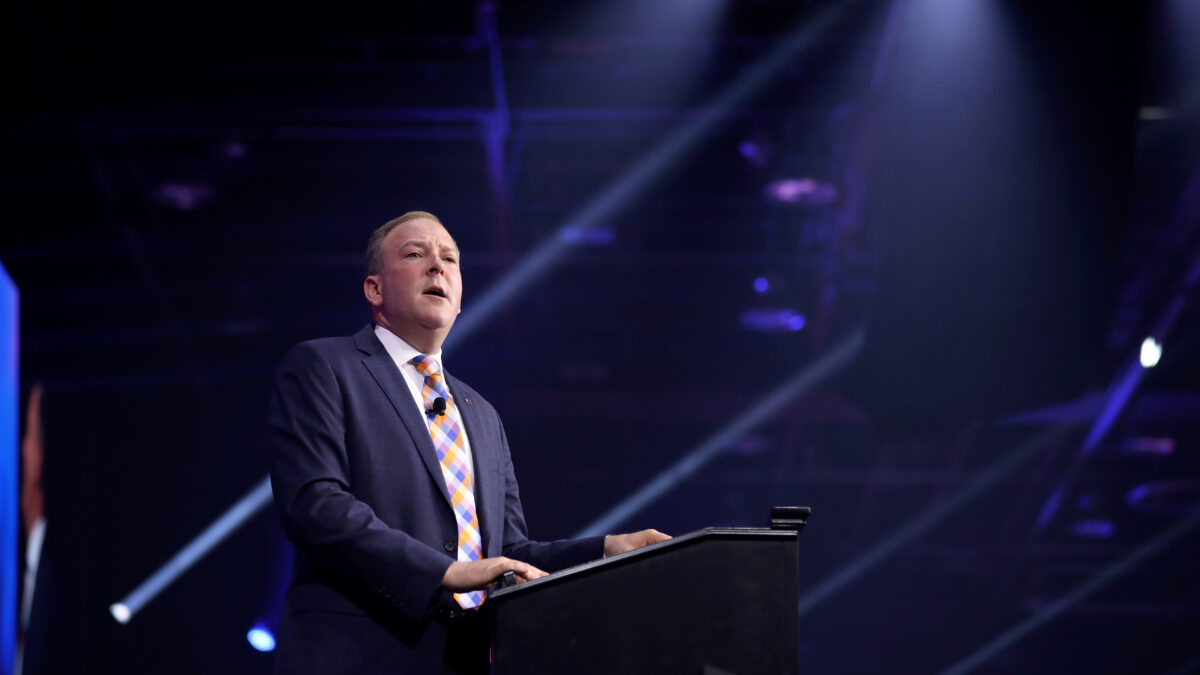
In 2022, when now-Environmental Protection Agency Administrator Lee Zeldin was running for governor of New York, his campaign was backed by two state-level super PACs that spent a combined $20 million boosting him and attacking his opponent, Gov. Kathy Hochul. A recently released investigative report suggests that donors tied to industries he now oversees in his EPA role may have sought to gain influence with him by financially supporting the super PACs without their names being publicly disclosed.
In late September, the two super PACs, Save Our State NY Inc. and Safe Together New York Inc., agreed, without admitting to wrongdoing, to pay $900,000 to settle allegations that they coordinated with Zeldin’s campaign in violation of state campaign finance law. The New York Times, which first reported on the close of the multi-year inquiry by the New York State Division of Election Law Enforcement, obtained the settlement agreement through a Freedom of Information request along with an investigative report supporting the enforcement agency’s conclusion that the super PACs had violated New York law and the rebuttal the super PACs filed in response.
In addition to detailing various connections and communications tying the PACs to Zeldin’s campaign, the investigative report indicates that there were efforts to avoid public disclosure of some of the donors supporting the pro-Zeldin campaign. In particular, the report cited evidence suggesting that “donors who did not want their names disclosed were encouraged to give to” the Republican Governors Association (RGA) “or to an RGA-affiliated PAC, rather than directly” to the super PACs.
Although the RGA publicly discloses its donors with the IRS, when it makes a super PAC contribution the recipient PAC only has to report the RGA as a donor, obscuring the true source of the funds that were used to make the contribution. This type of political funding, where PACs report other PACs as their contributors, has been referred to as “gray money” as it involves nominal transparency while making it difficult for the public to actually identify who is spending significant sums to support, and potentially influence, political candidates.
In late 2022, the RGA gave $3.95 million to Save Our State NY and $1.75 million to Safe Together New York. All but $700,000 of those funds were transferred on or after October 24, 2022, when Zeldin appeared as the featured guest at a RGA-hosted fundraising event in which he encouraged donors, particularly those who had already maxed out to his campaign, to give to the RGA or the two super PACs.
One day before the fundraising event, according to the investigative report, Ed Cox, the current chairman of the New York State Republican Party who was affiliated with Save Our State NY, stated in an email to former Sen. Rick Santorum that others had contributed to the RGA, which was supporting Zeldin through a super PAC. The report quoted Cox as writing, “to avoid disclosure of donors under NY law, RGA has to donate to a New York super PAC.”
After describing Cox’s email, Zeldin’s comments at the fundraising event, and the subsequent funds that flowed from the RGA to the two super PACs, the investigative report asserted that it “appears that at least some of these donors may have been seeking influence on behalf of certain industries, such as oil, gas, and fracking, should Zeldin be elected Governor of New York and did not want to appear publicly as a contributor.” The report moved on, however, without detailing who these donors were or the basis for pointing towards those particular industries.
The investigative report also describes evidence indicating that at least one other route was discussed for channeling anonymously-sourced funds into the pro-Zeldin effort. In particular, individuals tied to the Zeldin campaign and outside groups discussed the common “dark money” approach of raising money into nonprofits that can spend money influencing elections, either directly or through contributions to super PACs, while concealing their donors.
In a late May 2022 email exchange with an individual who helped form Safe Together New York, Arie Lipnick, a senior staffer on the Zeldin campaign, looped in political consultant Marty Obst, who could “speak to the Superpac (RGA).” According to the investigative report, Obst, whose firm had worked for both the RGA and Zeldin’s campaign, discussed both a super PAC called “A New New York” and a 501(c)(4) nonprofit organization called Get Families Back to Work.
During the email exchange, at least as described by the investigative report, Obst appears to have indicated that the nonprofit could act as a conduit for contributions to the super PAC. According to the report, Obst stated how “the 501(c)(4) is located at the RGA and all contributions to the c4 will be transferred to the Super PAC.” It was also stated during the exchange that the names of contributors are not disclosed.
Organizations like Get Families Back to Work, which was formed in 2021 and is officially related to the RGA, that are exempt from taxation under section 501(c)(4) of the tax code do not have to disclose their contributors and are allowed to spend money influencing elections, though such spending cannot be their primary activity. For these reasons, 501(c)(4) organizations are a common vehicle for dark money political spending.
It is unclear, however, if Get Families Back to Work was ultimately used as an avenue for anonymously backing Zeldin’s 2022 gubernatorial bid. Neither Save Our State NY nor Safe Together New York reported receiving contributions from the nonprofit. The RGA also did not receive any contributions from Get Families Back to Work in 2022, although another political organization related to the RGA called the American Comeback Committee did receive $2 million from the nonprofit. CREW was unable to identify a super PAC named A New New York registered in New York state or on the federal level, though it is possible it was an early name for what became Save Our State NY Inc, which registered in New York in late August 2022.
Regardless, Obst’s apparent description of how contributions to a nonprofit would be transferred to a super PAC highlights a pathway for anonymous spending that observers fear is regularly abused as super PACs that are required to disclose their donors are often affiliated with nonprofits that contribute large sums of money to them without disclosing their own donors. For instance, in the 2024 election cycle, the House Majority PAC, a super PAC aligned with House Democratic leaders, received more than $47 million from its “affiliated” nonprofit House Majority Forward, while the Congressional Leadership Fund, a federal super PAC with close ties to House Republican leaders, received more than $43 million from its “sister” nonprofit, the American Action Network.
The suggestion in the New York State Division of Election Law Enforcement’s investigative report that representatives of the energy industry may have sought to gain influence with Zeldin by making contributions to the effort to get him elected governor without their names being revealed underscores a further concern about dark money political spending. Without disclosure, the public has no way of knowing which particular interests may hold extra sway with politicians and elected officials who are in a position to shape public policy that affects their bottom lines as Zeldin now is in his role as EPA administrator, where he has been described as launching “a brazen assault on regulations,” including those impacting the oil and gas industry.
Photo by Gage Skidmore under Creative Commons license